Guide
Best Fountain Pens for Left-Handed Writers: The Underserved Guide
Published: 2026-04-17 · Updated: 2026-04-17
If you are a left-handed writer, you have probably been told — politely or otherwise — that fountain pens are “not really for you.” Smudged palms, scratchy nibs, and ink-smeared notebooks are the usual warnings. The truth is more nuanced. Fountain pens can absolutely work for lefties. You just need the right pen, the right nib, the right ink, and a little bit of self-knowledge about how your hand moves across the page.
This guide is written from a left-hander’s perspective, not a right-hander guessing at our problems. We will cover why fountain pens seem difficult, the three distinct lefty writing styles (each with different pen needs), the specific models that work best, and the fast-drying inks that keep your palm clean.
Why Fountain Pens Seem “Difficult” for Lefties
Two physical realities create the reputation:
1. You push the nib instead of pulling it. Right-handers drag a fountain pen nib across the page from left to right. The nib’s two tines trail behind the tipping, gliding smoothly. Left-handers, depending on grip, often push the nib forward. That can catch the tines on paper fibers and feel scratchy — or worse, cause the tines to dig in and skip.
2. Your hand travels over freshly laid ink. A fountain pen lays down a wetter, more pigment-rich line than a ballpoint. If your hand moves across that wet line before it dries (anywhere from 2 to 20 seconds depending on the ink), you get smudging on the page and ink on the side of your hand — the classic “silver pinky.”
These are real problems. But they are solvable problems, and the solutions are specific. Before picking a pen, you need to know your writing style. That is the single biggest factor in what will work for you.
The Three Lefty Writing Styles
Left-handers do not all write the same way. There are three broad styles, and they have very different needs.
Overwriter (Hooked)
Your hand curls up and over the top of the line you are writing. Your wrist is bent, and you look down at the nib from above. Overwriters drag the nib left-to-right just like right-handers — which means smudging is minimal, but the hand posture can be tough on nibs that are not smooth.
Your needs: A smooth nib, ideally with some flex to forgive varied pressure. Ink speed is less critical because your hand stays above the just-written line.
Underwriter
Your hand sits below the line of writing. Your wrist is straight, and your forearm angles up toward the top-right of the page. Underwriters get the best of both worlds — you are mostly pulling the nib (like right-handers) and your hand rarely travels over wet ink.
Your needs: Almost any fountain pen works well. You have the fewest problems of any lefty style. Congratulations — you drew the long straw.
Sidewriter
Your hand stays directly to the left of the line. The paper may be rotated 30-45 degrees clockwise to make this comfortable. You are pushing the nib upward at an angle, and your hand follows the line you just wrote.
Your needs: A wet-flowing nib that does not skip under push pressure, and a fast-drying ink. Smudging is your biggest enemy.
If you are not sure which you are, write a sentence and freeze your hand at the end. Compare it to the descriptions above. Most lefties are sidewriters or underwriters.
Nib Characteristics That Matter for Lefties
Not all nibs are created equal, and three properties matter most:
Flow. A well-tuned wet nib lays ink down smoothly even when you push rather than pull. A dry, stingy nib will skip and feel scratchy. For lefties, lean toward medium to wet flow. If you are coming from the beginner world, our nib size guide explains how flow relates to line width.
Tipping shape. Japanese nibs (Pilot, Sailor, Platinum) tend to have smaller, rounder tipping, which handles push-writing gracefully. German nibs (Lamy, Pelikan, Kaweco) often have larger tipping with flatter sweet spots, which can catch if your angle is off. Neither is better — but Japanese nibs forgive more lefty quirks.
Feedback vs. smooth. Some lefties prefer a bit of feedback (the pencil-on-paper feel) because it tells them when the nib is engaging the page. Others find feedback maddening and want glass-smooth. Try both before committing.
The gold nib vs steel nib debate is mostly irrelevant to your hand. A good steel nib writes better for a lefty than a poorly tuned gold nib.
The Fastest-Drying Inks for Left-Handers
Ink chemistry is the single biggest lever a lefty can pull. A slow-drying ink like Diamine Oxblood might take 20+ seconds to set on premium paper. A fast-drying ink can be touch-dry in 4-5 seconds. That difference is the difference between clean hands and a smeared mess.
Top Fast-Drying Picks
Pilot Iroshizuku Take-Sumi (black). Iroshizuku is known for being slow-drying overall, but Take-Sumi is the exception — a carbon-influenced black that sets quickly and remains beautifully saturated. Not all Iroshizuku colors are lefty-friendly, so pick carefully.
Waterman Serenity Blue. The classic lefty recommendation. Waterman inks are formulated on the dry side, flow cleanly, and dry fast on almost any paper. Serenity Blue (formerly Florida Blue) is the go-to.
Diamine Registrar’s Ink. An iron-gall ink that goes down blue-black and oxidizes to near-black permanence. Iron-gall chemistry dries faster than dye-based inks and is water-resistant once set. Requires more frequent pen cleaning — iron gall can be harsh on some materials — so pair with steel-nibbed pens.
Pelikan 4001 Royal Blue. Workhorse ink. Flows well, dries in 5-8 seconds on most paper, and costs half of Iroshizuku.
Noodler’s Bernanke Blue/Black. Specifically formulated by Noodler’s for fast-drying performance. Dries in 2-3 seconds on quality paper. Some lefties swear by these.
For deeper ink guidance across use cases, see our fountain pen inks guide.
Inks to Avoid (As a Lefty)
Iroshizuku Kon-Peki, most Sailor Jentle colors, Diamine shimmer/sheen inks, and anything marketed as “wet and lubricated” will smudge on you. Gorgeous inks — just not ones to put in your daily driver.
Best Fountain Pens for Lefties by Writing Style
Now the fun part: specific pen recommendations. These are organized by writing style, because that matters more than price.
Best for Overwriters
Pilot Kakuno (~$15). A Japanese fine nib is exactly what overwriters want — rounded tipping, excellent flow, forgiving of unusual hand angles. The smiley-face on the nib helps you verify orientation, which matters more with hooked grip. Cheap enough to be your gateway.
Pilot Custom 74 (~$160). If you love the Kakuno’s nib character, the Custom 74 is the same DNA with a soft 14K gold nib. The slight flex rewards overwriter pressure variation beautifully.
Lamy 2000 (~$200). A smooth 14K hooded nib, surprisingly wet, and the Makrolon body is grippy enough for hooked hand positions. Many overwriters call this their endgame pen.
Best for Underwriters
You have it easy — most pens work. But these shine:
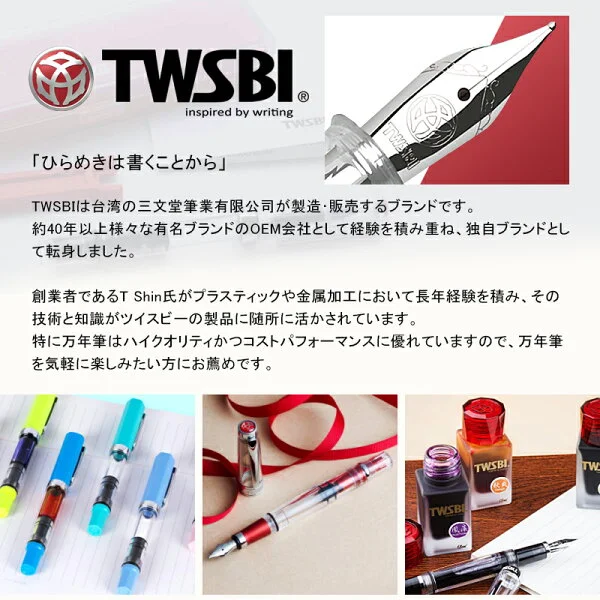
TWSBI ECO (~$35). Piston filler, large ink capacity, reliable JoWo steel nib. Our full take is in the Lamy Safari vs TWSBI ECO comparison. For underwriters, this is just a great pen, full stop.
Pilot Metropolitan (~$25). The universal recommendation for beginners of any handedness. Our beginner’s guide covers why it punches above its price.
Pelikan M200 (~$160). A traditional piston filler with a steel nib that writes like gold. No lefty-specific compromises needed.
Best for Sidewriters
Sidewriting is the hardest style to accommodate. You need wet flow, a forgiving nib shape, and tolerant geometry.
Lamy Safari with LH nib (~$30). This is one of the only mass-market pens sold with a dedicated left-handed nib. The LH grind is a slightly rounded, lightly upturned tipping that handles push-writing and unusual angles. Pair with fast-drying ink and the Safari becomes a sidewriter’s best friend at any price.
Pilot Metropolitan Fine (~$25). The rounded Japanese fine tipping handles push-writing surprisingly well. Wet enough to not skip, dry enough to not smudge badly.
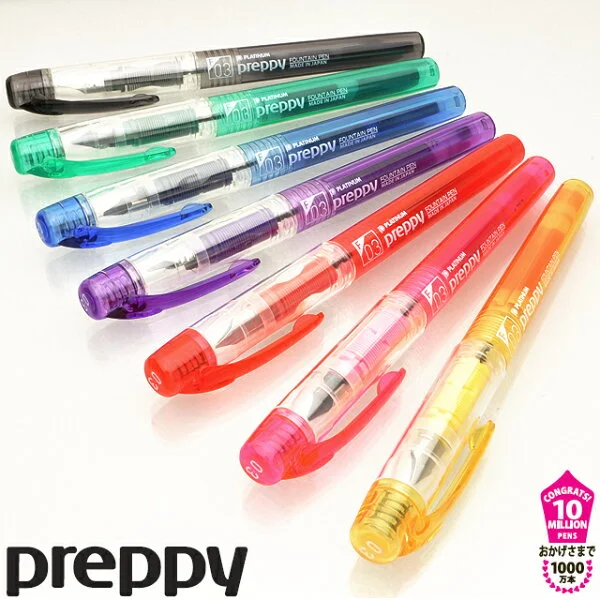
Platinum Preppy (~$6). Don’t sleep on this. The Preppy’s fine nib is unexpectedly great for sidewriters, and at $6 you can experiment without fear. The slip-and-seal cap also keeps it writing instantly even if you haven’t touched it for months.
Pelikan M205 with left-oblique nib (~$180). Pelikan offers LO (left-oblique) nibs by special order. The angled grind is cut specifically for sidewriters who rotate the pen. It is a serious investment and requires knowing your style precisely — but nothing else feels quite like it.
Dedicated Left-Handed Nibs: Do They Matter?
A true left-handed nib has one of two features:
- Rounded, slightly upturned tipping (Lamy’s “LH”) that reduces catching when pushed
- A left-oblique grind (Pelikan, some Sailor specialty nibs) where the tipping is angled to match a rotated paper position
Are they necessary? Honestly, no — not for most lefties. An underwriter does not need one. An overwriter with a smooth Japanese nib does not need one. Only sidewriters, and only those at the more extreme rotation angles, see a night-and-day improvement from a dedicated LH nib.
That said, the Lamy LH nib is $30 and swappable onto any Lamy Safari, Al-Star, or LX. It is worth trying even if you are not sure.
Paper Matters More Than You Think
A beautifully fast-drying ink on cheap copy paper will feather and take twice as long to set. The right paper can cut your drying time in half.
Look for paper explicitly marketed as fountain-pen-friendly: Rhodia, Clairefontaine, Tomoe River, Midori MD, and Kokuyo Campus are the usual suspects. But for lefties specifically, you want paper that is smooth but not too coated — highly coated papers like Tomoe River actually dry slower because the ink cannot absorb. A mid-absorbent option like Rhodia 80gsm is often the sweet spot.
Our dedicated best paper for fountain pens guide breaks down drying times by paper type.
Grip and Angle Adjustments
Before you blame the pen, check your grip. Three small adjustments help almost every lefty:
1. Rotate the paper. Right-handers are taught to keep paper straight. Ignore that. Rotate clockwise 20-45 degrees and your hand can relax into a more natural pulling motion.
2. Lower your grip. If you are choking the pen right at the nib, you are more likely to dig in. Hold the pen slightly further back — about a centimeter from the tipping — and let the nib glide.
3. Lighten your pressure. Fountain pens require less than a quarter of the pressure of a ballpoint. If your hand is tired after writing, you are pressing too hard. This is the single most common lefty mistake.
Honest Downsides
This is not an unqualified endorsement. Being a lefty with fountain pens comes with real tradeoffs:
- Ink selection is limited. Roughly half of the beautiful inks on the market are too slow-drying to use daily. You will miss out on some gorgeous colors.
- Spiral notebooks are awkward. The spiral is on your writing side. Switch to stitched or disc-bound notebooks (Leuchtturm, Midori) or flip spiral notebooks upside down.
- Fountain-pen-unfriendly paper is punishing. On cheap office paper, smudging gets much worse. Keep a small Rhodia pad at your desk.
- Maintenance matters more. Sidewriters in particular can slightly misalign nib tines over time. Regular cleaning — see our fountain pen care guide — keeps small issues from becoming expensive problems.
None of this is a dealbreaker. But if someone promises you that fountain pens are “just as easy” for lefties, they are oversimplifying.
FAQ
Do I need a special left-handed nib?
Only if you are a sidewriter, and even then it is optional. Overwriters and underwriters can use standard nibs without issue. A Japanese fine nib (Pilot, Sailor, Platinum) solves most lefty problems without any special grinding.
How do I stop my fountain pen from smudging?
In order of impact: switch to a fast-drying ink (Waterman Serenity Blue, Pelikan 4001, Noodler’s Bernanke), use fountain-pen-friendly paper that is absorbent rather than heavily coated, choose a finer nib to lay down less ink, and consider rotating your paper clockwise to reduce how much your hand passes over wet strokes.
Are all fountain pens hard for lefties?
No. Underwriters can use almost any pen. Overwriters do well with smooth Japanese nibs. Only sidewriters face real friction, and even that is solvable with the right nib and ink combination.
Is the Lamy Safari really better than a normal nib for lefties?
The Safari with an LH nib is meaningfully better for sidewriters. For overwriters and underwriters, the difference is minor. The good news is that Lamy nibs are swappable, so you can buy a standard Safari and add an LH nib later for about $15.
Can I use a gold nib as a lefty?
Yes. Gold nibs are no better or worse than steel for left-handers — the nib’s tipping shape and flow matter far more than the nib material. A tuned steel Pilot Metropolitan will outperform a poorly tuned gold nib every time.
Why do my fountain pens skip when I write?
For lefties, skipping usually has one of three causes: pushing a dry nib (switch to a wetter flow or finer tipping), holding the pen at a too-steep angle (lower your grip or rotate the paper), or pressing too hard (lighten up — fountain pens write with almost no pressure).
What about left-handed calligraphy?
Calligraphy is a whole separate discipline. For left-handed calligraphy, oblique holders and specialty nibs (Leonardt, Brause) are common. That is outside the scope of everyday writing, but the fast-drying ink and paper advice in this guide still applies.
Final Thoughts
Being left-handed does not shut you out of fountain pens. It just means you need to be more intentional. Figure out your writing style first. Then pick a pen with good flow and forgiving tipping — a Pilot Metropolitan or a Lamy Safari with an LH nib is a nearly foolproof starting point. Load it with Waterman Serenity Blue or another fast-dryer. Write on Rhodia or similar paper. Adjust your grip and paper angle.
If you do those things, the “lefties can’t use fountain pens” myth disappears. You will write with cleaner hands, smoother lines, and more pleasure than you ever did with ballpoints. The market has ignored us for a long time. The pens that actually work for us are out there — you just have to know where to look.
🖊️ Featured Pens in This Article