Guide
Best Fountain Pens Under $200: Where Quality Meets Value
Published: 2026-04-25 · Updated: 2026-04-25
The under-$200 bracket is where fountain pens stop apologizing for their price. Below $100, you are usually celebrating how much pen you got for the money. Above $300, you are paying for prestige, materials, and brand mythology. But at $100 to $200, you get pens that quietly do everything right — gold nibs, refined filling systems, build quality that lasts decades — without the collector-market markup.
I have spent the last two years cycling through the most recommended pens in this range, and the shortlist below represents what I actually reach for. These are not “good for the price” pens. They are simply good pens.
What $200 Buys You in 2026
Prices have climbed noticeably since 2023. Yen weakness, supply chain issues, and post-pandemic brand repositioning have pushed some flagship Japanese pens over $200 that used to sit comfortably below it. Still, this range remains the most interesting tier in fountain pens. Here is what you should expect:
- A real gold nib on most picks (14K or 18K), with meaningful flex and character
- Premium filling systems — piston, vacuum, and precision converters rather than generic international cartridges
- Materials that last — Makrolon, cellulose acetate, and proper metal trim instead of painted plastic
- Tuning and QC that reflects a real hand at the factory, not a template
What you do NOT get at this price: urushi lacquer, solid sterling, maki-e art, or the cachet of a Pelikan M800. That is fine. The writing experience at $200 can be 90% of what $600 delivers.
If you are still climbing the ladder, my guide to pens under $100 covers the tier below. And if you are brand new, start with the beginner’s guide.
Our Top Picks
Lamy 2000 (~$170) — Best Design Icon
The Lamy 2000 was released in 1966 and has not been meaningfully redesigned in sixty years. That is not laziness — Gerd Alfred Müller’s Bauhaus-influenced design was simply correct the first time. The Makrolon (fiberglass-reinforced polycarbonate) barrel has a brushed finish that feels warm in hand and hides fingerprints. The semi-hooded 14K gold nib is tuned with a slight spring, and the piston filler holds a generous amount of ink.
It is one of the few pens where the industrial design philosophy is visible in every line. Nothing is decorative. Every surface serves a purpose. The clip hides a spring mechanism. The brushed finish disguises wear. The brass internals give it reassuring heft.
What I dislike: the semi-hooded nib is divisive. Some samples have been reported as slightly dry or misaligned. Lamy’s QC on the 2000 has been inconsistent in recent years, and you may need to adjust the nib or send it to a nibmeister to get it writing ideally.
Best for: Writers who value timeless design and do not need a showy pen. The 2000 looks like a simple cylinder and writes like a modern classic.
Nib recommendation: Medium (M). The semi-hooded design already makes writing feel slightly finer than stated, so start at the middle.
Pilot Custom 74 (~$160) — Best Japanese Workhorse
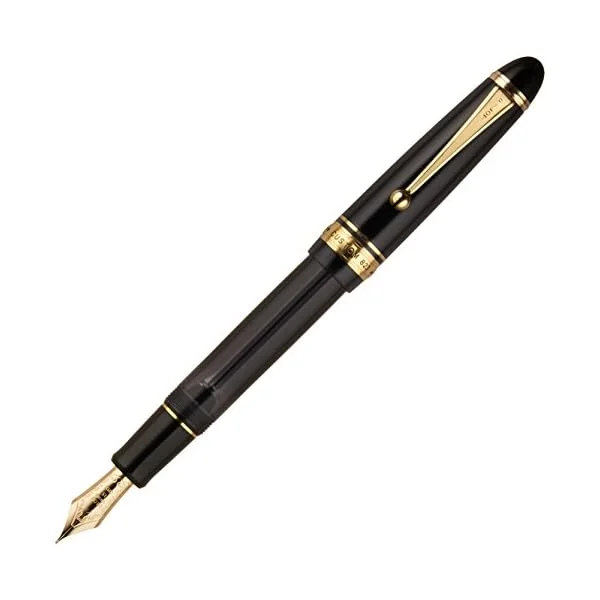
If I could only recommend one pen in this entire bracket, it would be the Custom 74. Pilot’s 14K gold nib is universally praised for its smoothness — writing with a Custom 74 feels almost frictionless, like gliding over glass. The barrel is clear or translucent resin, reminding you that this pen is built to be used, not displayed.
The filling system uses Pilot’s CON-70 converter, which holds more ink than almost any converter on the market. Combine that with a tuned gold nib, and you have a pen that writes continuously for a week without refilling.
The Custom 74 is also remarkable for its nib selection — you can get it in Soft Fine (SF), Soft Medium (SM), Fine Medium (FM), and more specialty grinds if you know where to look. See my nib size guide for how to choose.
What I dislike: the styling is conservative — some would say boring. The cap band is a little fussy. It does not feel as “built” as the Lamy 2000, though it writes arguably better.
Best for: Anyone who cares more about writing than appearance. This is the gold nib equivalent of a well-tuned tool.
Nib recommendation: Soft Fine (SF) or Fine Medium (FM). The soft nib adds subtle line variation without being a true flex nib.
TWSBI Vac700R (~$85) — Best Ink Capacity
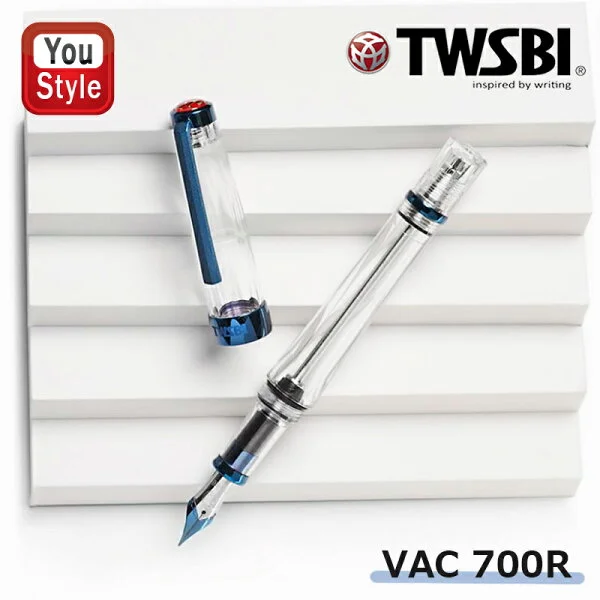
This is the only pen on this list well under $100, and it earns its place on technical merit. The Vac700R brings vacuum filling — a technology normally reserved for $300+ pens — into accessible territory. The plunger mechanism draws roughly 2.0ml of ink in a single stroke, which is more than most cartridge/converter setups hold combined.
The writing experience is not quite at the level of the Custom 74 or Lamy 2000. The steel nib is smooth but lacks character. Where the Vac700R shines is in practicality — the massive capacity means you refill far less often, and the built-in shut-off valve lets you close the ink feed for air travel without leaks.
I include this in a $200 list because it represents an honest question: do you want a gold nib with 0.7ml of ink, or do you want three times that capacity in steel? For daily journalers, the answer is often the Vac700R.
Best for: Heavy writers and travelers. The shut-off valve genuinely works — I have flown with this pen six times and never had a leak.
Nib recommendation: Fine or Medium. TWSBI nibs run slightly wet, so Fine gives you a nice everyday line.
Pelikan M205 (~$130) — Best European Classic
The M205 is the entry point into Pelikan’s celebrated piston-fill lineup, and it carries the same design DNA as the much more expensive M800. You get a proper piston filler, real Pelikan build quality, and a steel nib that punches far above its weight.
Pelikan’s piston mechanism is legendary. The M205 uses the same precision-machined piston as pens three times the price. The ink window allows you to see when you are running low, and the transparent demonstrator versions reveal the beautiful internal engineering.
Here is the upgrade secret: the M205 shares a nib unit with the M400. That means if you start with the steel-nibbed M205 at $130 and later want a gold nib, you can swap in an M400 14K gold nib for roughly $100 — still ending up well under $250 for what is essentially a Pelikan M400 with better color options. Combined with my gold vs steel nib guide, this is a smart long-term play.
What I dislike: the M205 is smaller than the M400/M600/M800. If you have large hands, it may feel cramped unposted. The steel nib is well-tuned but not magical.
Best for: Writers who want heritage and a proper piston filler without committing to a gold nib yet.
Nib recommendation: Medium (M). Pelikan nibs tend to run slightly broad by Japanese standards, so their Medium is a pleasant daily line.
Sailor Profit Junior +10 (~$120) — Best Small Gold Nib
The Profit Junior is Sailor’s smallest and most underrated pen. It uses a 14K gold nib — yes, gold — on a pocket-sized body, making it one of the most affordable ways to experience Sailor’s famous nib feedback.
Sailor nibs are distinctive. Where Pilot writes like glass, Sailor writes with a pencil-like tactile feedback that some describe as “paper feel.” You can sense every fiber of the page beneath the nib. It is not scratchy — it is controlled texture, and many writers find it addictive once they try it.
The Profit Junior is pocket-small. Capped it measures about 118mm, which is shorter than most pens. You must post the cap to write comfortably — and when posted, the balance is surprisingly good.
What I dislike: small ink capacity (it uses Sailor’s short converter or cartridges), and the 14K nib, while characterful, is not as refined as the larger Pro Gear nibs.
Best for: Writers who want to try Sailor’s feedback without paying Pro Gear prices. Also excellent as a pocket-carry pen.
Nib recommendation: Medium Fine (MF). This Sailor-specific size sits between Japanese Fine and Medium and is the best-balanced nib in the Profit Junior lineup.
Pilot Vanishing Point (~$180) — Best Engineering Marvel
The Vanishing Point is a fountain pen with a retractable 18K gold nib. Click the button at the top, like a ballpoint, and the nib extends. Click again, and it retracts behind a spring-loaded door that seals against dry-out.
It sounds like a gimmick. It is not. The Vanishing Point is one of Pilot’s most engineered products, and it solves a real problem — fountain pens are usually terrible for quick note-taking because you have to uncap them two-handed. The VP is genuinely usable one-handed, like a ballpoint, but writes like the gold nib fountain pen it is.
The clip is positioned at the nib end, which takes getting used to. Your fingers rest against or near the clip. Most people adapt within a week. Some never do — this is the single biggest reason people return the pen.
What I dislike: the clip position is a real issue for some grips. The pen is also slightly heavier than a typical pen this size due to the internal mechanism.
Best for: Writers who take rapid notes throughout the day and want fountain pen writing without uncapping ceremony. Also great for travel and meetings.
Nib recommendation: Fine (F). Japanese Fine on the VP is precise and perfect for note-taking.
Comparison Table
| Pen | Price | Nib | Filling System | Best For |
|---|---|---|---|---|
| Lamy 2000 | ~$170 | 14K gold, semi-hooded | Piston | Iconic design |
| Pilot Custom 74 | ~$160 | 14K gold | CON-70 converter | Daily writer |
| TWSBI Vac700R | ~$85 | Steel | Vacuum | Ink capacity |
| Pelikan M205 | ~$130 | Steel (upgradable) | Piston | European classic |
| Sailor Profit Jr. +10 | ~$120 | 14K gold | Cartridge/converter | Pocket carry |
| Pilot Vanishing Point | ~$180 | 18K gold | Cartridge/converter | Rapid note-taking |
Nib Upgrade Options
One of the underrated advantages of this price bracket is that you can spend a bit more on aftermarket nib work and end up with something genuinely custom. Some common upgrade paths:
- Pelikan M205 → M400 gold nib swap: Adds ~$100 for a proper 14K gold Pelikan nib
- Pilot Custom 74 → nibmeister regrind: A $60-80 regrind to a Cursive Italic or Architect’s grind transforms a standard nib into a signature writing instrument
- Lamy 2000 → aftermarket smoothing: Many QC issues on the 2000 can be fixed by a nibmeister for $40-60
A reputable nibmeister can grind or tune any of the pens on this list, and the investment often doubles the character of the pen. Search for respected names in the community — Mark Bacas, Dan Smith, and Matthew Chen have all built reputations for quality work.
Value vs Prestige
It is worth naming the honest trade-off in this price range. You are paying somewhere between “value sweet spot” and “prestige entry ticket.” Here is how I think about it:
- Pure value: Vac700R, Pelikan M205 (both deliver materials and engineering that feel more expensive than they are)
- Balanced: Custom 74, Profit Junior (real gold nibs at honest prices)
- Prestige-leaning: Lamy 2000, Vanishing Point (you pay partly for the brand and design heritage)
None of these is wrong. A pen you love because of what it represents is worth owning. Just be honest with yourself about what you are paying for.
When to Skip and Save More
Sometimes the right move is to not buy anything in this range. A few situations where I would recommend saving up:
- You already own a great $50-100 pen. If your TWSBI Eco or Platinum 3776 is writing well, the upgrades in this range are incremental. Save $100 more and jump to a Pelikan M400 or Pilot Custom 823.
- You are chasing flex. Modern pens under $200 do not really flex. If vintage-style line variation is your goal, save for a Pilot Falcon ($250+) or buy a vintage Waterman on eBay.
- You want urushi, maki-e, or sterling. These materials start around $300-400. There is no shortcut.
Before you click buy, also read my notes on fountain pen care and maintenance — a well-maintained $100 pen outperforms a neglected $200 pen every time. And do not forget paper and ink — these matter as much as the pen itself.
FAQ
Is a gold nib worth the extra money at this price?
Usually yes, but not always. Gold nibs offer subtle spring, warmth, and character that steel cannot replicate. However, a well-tuned steel nib (like on the Vac700R or M205) writes wonderfully. If you have never used a gold nib, the Custom 74 at $160 is the cleanest introduction.
Which pen on this list has the best ink capacity?
The TWSBI Vac700R at roughly 2.0ml. Second place goes to the Pelikan M205’s piston at about 1.4ml. The cartridge/converter pens (VP, Profit Junior) hold the least at around 0.7-1.0ml.
Are these pens good for daily use?
All of them, yes. The Custom 74, Vanishing Point, and Vac700R are particularly well-suited to daily work. The Lamy 2000 is durable despite looking delicate. The Sailor Profit Junior is best as a secondary carry rather than a primary.
What about the Pilot Custom 823?
The 823 is excellent but usually sits just above $250, so it falls outside this list. If you can stretch, it is one of the best pens in the entire sub-$300 market. See my Pilot vs Sailor comparison for more on how Pilot’s higher-end pens compare.
How do I choose between the Lamy 2000 and the Pilot Custom 74?
The 2000 is an object — you buy it partly for the design. The Custom 74 is a writing tool — you buy it to write. If you want something that looks right on your desk, choose the 2000. If you want something that writes so well you forget about the pen, choose the 74.
Is the Vanishing Point really usable as a daily pen?
Yes, if the clip position works for your grip. Try it in-store if possible, or buy from a retailer with a return policy. About 70% of people adapt easily, 20% adapt over time, and 10% never find it comfortable.
Can I flex these nibs?
Not really. The Lamy 2000 and Custom 74 have slight spring. The Soft Fine variant of the Custom 74 has a bit more give. For true flex, you need dedicated flex nibs or vintage pens.
Which one is the best overall value?
The Pilot Custom 74 at $160. You get a 14K gold nib, Pilot’s excellent tuning, a high-capacity converter, and decades-tested reliability. Nothing else in this range matches that combination for pure writing experience.
Final Thoughts
If I had to pick one pen from this list for a writer ready to graduate from sub-$100 pens, it would be the Pilot Custom 74. It is not the flashiest or the most engineered, but it delivers the most writing pleasure per dollar in this tier.
That said, all six pens here have earned their place. The Lamy 2000 is a design object. The Vanishing Point is an engineering marvel. The M205 is a gateway to the Pelikan world. The Profit Junior is the cheapest path to Sailor’s distinctive feedback. The Vac700R is the practical workhorse.
$200 is the right amount of money to spend on a pen you will use for twenty years. Pick one, ink it up, and start writing.
🖊️ Featured Pens in This Article