Guide
Best Travel Fountain Pens: Picks for Journalers and Business Travelers
Published: 2026-04-18 · Updated: 2026-04-18
A fountain pen in your pocket changes how you travel. Journal entries take on a weight that a ballpoint cannot match, and signing a contract in a foreign city feels a little less ordinary. But travel is also the single most hostile environment you can put a fountain pen in. Cabin pressure changes, jostling in a backpack, sudden temperature swings, and the ever-present risk of a capped nib pointing the wrong way in your jacket — these are the forces that separate a good travel pen from one that ruins a shirt.
After years of flying with fountain pens, filling them in hotel sinks, and cleaning ink off the occasional laptop bag, we have a clear picture of what works. This guide walks through the best travel fountain pens across five categories, explains the real reasons some pens leak on planes and others do not, and gives you a packing checklist that actually holds up.
Why Travel Pens Need Different Criteria
A desk pen and a travel pen are not evaluated on the same scale. At home, a beautiful piston filler that stays nib-up in a leather stand is a joy. On a flight, that same pen is a small bomb of saturated ink waiting for a pressure drop.
The criteria shift completely once you leave the house:
- Sealing quality of the cap. This is the single biggest factor. A cap with a strong inner seal keeps ink from evaporating and reduces the nib-drying hard starts that plague travel.
- Filling system resilience. Cartridges are the safest in changing pressure; piston fillers the most vulnerable. More on this below.
- Weight and pocket-friendliness. A 45-gram brass pen is punishment on a long flight.
- Clip strength. A weak clip means a pen that falls out of a shirt pocket mid-taxi.
- Refill availability. If your pen takes a proprietary cartridge only sold in one country, you are in trouble when you run out in Berlin.
- Durability against drops. Hotel floors are usually hard.
A pen that scores well on three of these but fails on one can still ruin a trip. For a broader view of what makes any pen worth buying, our beginner’s guide covers the fundamentals.
Airplane Pressure and Ink Spills: The Real Physics
The “fountain pens leak on planes” story is both true and overstated. Here is what actually happens.
At cruising altitude, cabin pressure is lower than at sea level — roughly equivalent to being at 6,000 to 8,000 feet of elevation. If the air trapped inside your pen’s barrel was sealed at sea-level pressure, it expands as the cabin depressurizes. That expansion pushes ink out through the feed and past the nib. A full pen has little room for the air to expand, so the ink has nowhere to go but out. An empty pen has nothing to push.
Three practical rules follow:
- Fly with the pen completely full or completely empty. A half-full pen is the worst-case scenario — plenty of air to expand and plenty of ink to push.
- Keep the pen nib-up. If ink does get past the feed, gravity keeps it pooled at the back of the barrel rather than running out the front.
- Cartridge-based pens are safer than piston fillers. The small air pocket in a cartridge is far smaller than the air column in a large piston filler, so the volume of displaced ink is smaller too.
You will see lots of advice online saying fountain pens “never” leak on planes. That is survivorship bias. They leak enough that this section exists in every serious travel guide. For a deeper look at how different systems handle ink, see our fountain pen filling systems guide.
Category 1: Pocket and Short Pens
Short pens are the natural answer to “what pen do I carry?” when the answer also has to be “in my jeans.” These pens are designed to cap-post (the cap snaps onto the back of the barrel) to reach usable writing length.
Kaweco Sport (~$30 plastic, ~$90 AL Sport)
The Kaweco Sport is the default travel fountain pen for a reason. Capped, it is 4.1 inches long — shorter than most ballpoints. Posted, it extends to a comfortable 5.2 inches. The octagonal faceted body keeps it from rolling off cafe tables, and the threaded cap creates a genuinely good seal.
Pros:
- Short enough for any pocket, including shirt pockets
- Excellent cap seal resists drying and reduces pressure issues
- Standard international short cartridges — available worldwide
- AL Sport (aluminum) and Brass Sport versions are effectively indestructible
Cons:
- The plastic Classic Sport has no clip included by default (sold separately)
- Small ink capacity on cartridges (~0.7ml)
- The nib is functional rather than exceptional
Kaweco Liliput (~$75)
If the Sport is a pocket pen, the Liliput is a keychain pen. At 3.8 inches capped and weighing around 12 grams, it is astonishingly compact. The machined aluminum or brass body feels like a piece of engineering sample stock.
Pros:
- The smallest usable fountain pen on the market
- Metal body survives serious abuse
- Screw-cap seal is excellent
Cons:
- No clip (you will lose it if you do not have a pen sleeve)
- Must be posted to write — unposted it is uncomfortably short
- Only accepts one short international cartridge at a time
TWSBI Mini (~$60)
A miniaturized piston filler. The TWSBI Mini brings the transparent, mechanical charm of the full-size TWSBI Eco into a 4.4-inch capped form that expands to a proper 5.8-inch writing length when posted.
Pros:
- Piston filling means significantly more ink capacity than the Kaweco Sport’s cartridge
- The demonstrator body is beautiful
- Posts securely with a screw mechanism (not friction)
Cons:
- Piston fillers are more vulnerable to airplane pressure — pack it empty or completely full
- The threaded posting is slower than a quick cap snap
- Nib quality is inconsistent; some units need tuning
TWSBI Eco-T (~$35)
Not as small as the others in this category, but worth mentioning for travelers who want the Eco’s huge ink capacity in a slightly more pocket-friendly package. The faceted “T” design keeps it from rolling and adds a bit of grip.
Pros:
- Excellent ink capacity for multi-day trips without refills
- Best value piston filler at this size
- Faceted design is practical and attractive
Cons:
- At 5.5 inches capped, it is not a pocket pen — more of a bag pen
- Piston filler vulnerability to pressure changes
- Plastic build is less drop-resistant than metal alternatives
For more budget-friendly options at various sizes, our best fountain pens under $50 guide goes deeper.
Category 2: Carry-Everyday Full-Size
These are pens you wear like a watch — clipped in a shirt or jacket pocket every day, including travel days.
Pilot Vanishing Point (~$180)
The only mainstream retractable fountain pen with a real gold nib. Click the knock at the back and the nib emerges through a trapdoor at the front. No cap to lose, no cap to unscrew, and — crucially for travel — a spring-loaded inner shutter that seals the nib when retracted.
Pros:
- One-handed operation, like a ballpoint
- The inner shutter is a remarkably good seal; resists drying and handles pressure changes well
- 18K gold nib writes smoothly out of the box
- Clip placement (at the nib end) keeps the pen nib-up in a pocket by default — the single best feature for travel
Cons:
- The clip placement divides opinion; some grips naturally want to hold where the clip is
- Heavier than most pens at ~30 grams, which can fatigue over long writing sessions
- Replacement nib units are not cheap (~$150 for an 18K replacement)
Pilot Decimo (~$180)
The same retractable mechanism as the Vanishing Point in a slimmer, lighter body. If the Vanishing Point feels too heavy, the Decimo solves that at the cost of slightly reduced ink capacity.
Pros:
- All the travel advantages of the Vanishing Point with less weight
- Slimmer profile fits smaller hands and thinner pockets
- Same nib quality
Cons:
- Feels less substantial in hand; some writers miss the heft
- Slightly smaller ink window
- Same clip-placement debate applies
Lamy 2000 (~$200)
The cult classic. Designed in 1966, still in production unchanged. Makrolon (fiberglass-reinforced resin) body with brushed steel accents, hooded 14K gold nib, and a piston filler that holds an enormous amount of ink.
Pros:
- Genuinely iconic design that reads as professional in any setting
- Hooded nib is well-protected and the spring clip grips firmly
- Piston capacity (~1.4ml) is excellent for long trips
Cons:
- Piston filler — carry it empty or completely full on flights
- Nib quality control is famously inconsistent; budget for a possible tune-up
- The hooded nib does not allow for easy cleaning without full disassembly
Category 3: Budget Daily Beaters
The pen you actually want in a backpack that gets tossed around. If it gets lost or damaged, the sting is bearable.
Lamy Safari (~$30)
The beginner’s pen that also makes an outstanding travel pen. Durable ABS plastic body, a wire clip strong enough to survive years of abuse, and a triangular grip that forces consistent finger placement.
Pros:
- Nearly indestructible
- Cartridge/converter system — use standard Lamy cartridges for worry-free flying
- Replacement nibs are cheap (~$15) and user-installable
- The clip is one of the most reliable in all of fountain pens
Cons:
- The triangular grip is polarizing; left-handers especially may dislike it
- Proprietary Lamy cartridges are not always available outside major cities
- Not a pocket pen — it is 5.5 inches capped
For left-handed writers evaluating the Safari and alternatives, see our left-handed fountain pens guide.
Pilot Metropolitan (~$20)
Outperforms its price in every way that matters. Brass body gives it real weight and durability, the nib is smooth from the factory with almost zero quality variance, and the cartridge/converter system handles cabin pressure without drama.
Pros:
- Arguably the most reliable fountain pen nib under $100
- Metal construction survives drops
- Cheap enough that replacement if lost is not devastating
Cons:
- The included converter is a squeeze-type with small capacity; upgrade to a CON-40 for travel
- Only available in Fine and Medium
- The clip is functional but not confidence-inspiring
TWSBI Eco (~$35)
The full-size Eco is a better travel pen than most people give it credit for, provided you follow the pressure rules. Enormous ink capacity means fewer refills on long trips.
Pros:
- The biggest ink capacity in the budget category (~2.0ml)
- Replaceable nib units let you match writing size to the notebook you are using
- Demonstrator body makes ink level always visible
Cons:
- Piston filler — pack full or empty, never half
- Clip is a thin metal strip that can bend
- The cap threads can feel loose after heavy use
Jinhao 82 (~$10)
The surprise entry. Chinese brand Jinhao has quietly become a real contender in budget pens, and the 82 is the standout. Acrylic body, smooth #6 nib, and a cartridge/converter system — all for the price of a fancy coffee.
Pros:
- Travel-loss insurance: at $10, who cares if it disappears
- Cartridge/converter system handles pressure well
- Nib is genuinely good; many users prefer it to pens costing 5x more
Cons:
- Quality control is improving but still variable
- Finish on the acrylic can scratch easily
- Clip is decorative more than functional
Category 4: Business Travel Dress-Up
The pen you pull out when you are signing a term sheet, not journaling in an airport. These pens signal care without shouting.
Pelikan M400 (~$450)
The smaller sibling of the legendary M800. Compact enough to fit comfortably in a jacket pocket, with the signature striped barrel and bi-color 14K gold nib. Pelikan’s piston mechanism is arguably the best in the industry.
Pros:
- Impeccable build; the pen will outlast you
- The M400 size is ideal for travel — not too large, not too small
- The nib can be unscrewed and swapped (Pelikan nibs are modular)
Cons:
- Piston filler — standard pressure precautions apply
- At this price, losing it genuinely hurts
- Traditional styling may feel conservative for some settings
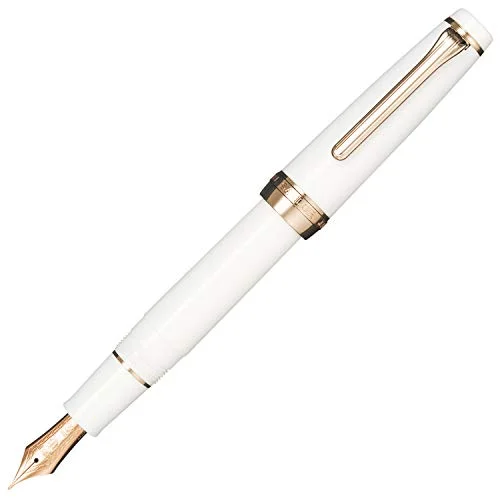
Sailor Pro Gear Slim (~$220)
The Pro Gear Slim (also called Pro Gear Mini in some markets) is a compact version of Sailor’s flagship design. Faceted cap, 14K gold nib with Sailor’s distinctive feedback, and a cartridge/converter system that makes it a true travel-friendly gold nib pen.
Pros:
- One of the few gold-nib pens with a cartridge/converter system — better for flying than piston alternatives
- The “pencil-like” Sailor nib feedback is unique and addictive
- Pocket-friendly size
Cons:
- Small ink capacity (the converter holds only ~0.5ml)
- Proprietary Sailor cartridges less common outside Japan, the US, and major European cities
- Not as visually striking as some alternatives at this price
Pilot Custom 74 (~$160)
The best value gold nib travel pen, full stop. Demonstrator body, 14K gold nib, and a CON-70 converter with unusually large capacity for a cartridge/converter pen.
Pros:
- 14K gold nib at a price where competitors are still selling steel
- Cartridge/converter system — flight-friendly
- The CON-70 converter holds nearly as much ink as many piston fillers
- Pilot’s nib quality control is legendary
Cons:
- The demonstrator body looks less “executive” than traditional options
- Only available in a handful of colors
- The cap posts but pushes the balance back awkwardly
Category 5: Ultimate Travel Pieces
Pens designed from the ground up for travel, with engineered sealing systems and accessories built for the road.
Visconti Travel Ink System / Homo Sapiens Dark Age (~$800+)
Visconti makes some of the most engineered travel-oriented pens on the market. The Homo Sapiens line uses a volcanic basalt body that is genuinely waterproof, with Visconti’s patented hook-safe lock cap and an oversized 23K Pd/Ag nib. Pair it with Visconti’s travel ink system — a sealed ink capsule you can carry in a shirt pocket.
Pros:
- Built specifically for travel; the engineering shows
- The hook-safe cap is one of the most secure on any pen
- Genuinely distinctive looking; a conversation piece
Cons:
- At $800+, this is a significant investment
- The weight (~40g) is substantial
- Visconti quality control has been inconsistent in recent years; buy from an authorized dealer with good return policy
Montblanc Meisterstuck 146 (~$700)
A traditional choice, but worth noting: the 146 size is the “travel” Meisterstuck. Large enough to be a serious writing instrument, small enough to comfortably carry. Piston filler with a snap-in cap that seals well.
Pros:
- Universally recognized as a business-class writing instrument
- The 146 size is better for pocket carry than the larger 149
- Excellent service and repair network worldwide
Cons:
- Piston filler — standard pressure rules apply
- The status-symbol associations are not for everyone
- Overpriced relative to equivalent quality from Japanese brands
Filling Systems Ranked for Travel
If you take nothing else from this guide, take this. For travel safety, filling systems rank in this order:
- Cartridge (safest). The small sealed volume of air inside a cartridge minimizes pressure displacement. Easy to swap in flight if needed.
- Cartridge/converter. Slightly worse than cartridge-only because the converter introduces more air volume, but still quite safe if filled fully.
- Piston filler (riskier). Large air column in the barrel. Must be fully full or fully empty for flight safety.
- Vacuum filler (risky, but manageable). Pens with a shut-off valve (like the TWSBI Vac700R) can be closed off entirely, which actually makes them very safe. Pens without one are the worst case.
- Eyedropper (most risky). The entire barrel is ink, sealed only by the section’s threads. Heat and pressure changes can force ink past the feed easily. Generally avoid for air travel.
For a more detailed explanation of how each system works day-to-day, see our filling systems guide.
Packing Tips That Actually Work
- Nib up, always. Store pens vertically in your bag with nibs pointing up. Use a pen sleeve or a dedicated pocket; do not let them rattle loose.
- Fill completely full or completely empty. Never half. If you cannot fully fill before a flight, empty and clean the pen before packing.
- Wrap ink bottles in a sealed plastic bag. Even “sealed” ink bottles leak at altitude, especially when checked. Double-bag them and pack in checked luggage if you must bring full bottles — TSA has been known to flag unusual liquids.
- Carry cartridges as a backup. Even if you use a piston filler daily, pack a handful of international standard cartridges. If your main pen fails, you can refill via syringe or switch to a cartridge-based backup.
- Do not check your fountain pens. The pressure changes in the cargo hold are more severe than in the cabin, and baggage handlers treat bags the way they do. Keep pens in your carry-on.
- Pack a microfiber cloth. For cleaning unexpected ink, for nib wiping, for drying after filling in a hotel sink.
- Know the paper situation. Hotel stationery is often fountain-pen hostile. For serious journaling, bring your own notebook. Our paper guide covers the best options.
For longer trips, a cleaning routine matters. Our fountain pen care and maintenance guide covers how to flush a pen in a hotel room and deal with dried nibs after time zones confuse your writing schedule.
Honest Downsides Nobody Tells You
No fountain pen is truly leak-proof. The ones that come closest — the Pilot Vanishing Point, the Kaweco Sport with its threaded cap, the TWSBI Vac700R with its shut-off valve — all have specific scenarios in which they will still stain a shirt. Anyone who claims otherwise has not flown enough.
Checked luggage is where the worst stories come from. Even a perfectly packed pen can suffer nib damage if a bag is thrown hard enough. If the pen matters to you, it flies with you.
Ink dries faster in airplane cabins than at home. The air in a 787 is drier than most deserts. Even a well-sealed pen may need a few scribbles to get going after a transatlantic flight. This is normal and not a defect.
Refilling on the road is harder than you think. If your favorite ink is not locally available, you will run out. Sample vials are a traveler’s best friend — they take up almost no space and carry enough ink for a multi-day trip. Our fountain pen inks guide covers the most reliable ink brands for travel.
FAQ
Do fountain pens leak on planes?
They can, but it is avoidable. The cause is cabin pressure dropping at altitude, which expands air inside the pen and pushes ink past the feed. Flying with the pen completely full or completely empty, nib-up, and ideally with a cartridge-based filling system eliminates the problem in nearly all cases.
What is the best filling system for travel?
Cartridge and cartridge/converter pens are the safest because the sealed air volume is smaller. Piston and eyedropper fillers are more vulnerable. Pens with shut-off valves (like vacuum fillers) are safe if you remember to close the valve before flying.
Is the Pilot Vanishing Point worth it for travel?
Yes, if the clip placement works for your grip. The retractable nib with spring-loaded inner shutter is the single best sealing mechanism on any production pen, and the clip placement keeps the pen nib-up in a pocket automatically — which also reduces ink pooling at the feed.
Can I bring fountain pen ink on a plane?
Yes, but treat it like any liquid. Ink bottles under 100ml (3.4oz) can go in carry-on following standard TSA rules. Always double-bag ink bottles. Some travelers prefer sample vials for short trips — they are smaller than the carry-on liquid limit and much less prone to disaster.
What is the best pocket fountain pen?
The Kaweco Sport is the default answer for most travelers — small, sealed cap, widely available cartridges. The Kaweco Liliput is smaller still but has no clip. The TWSBI Mini is a good option if you want a piston filler in pocket size.
Should I carry a fountain pen in my shirt pocket during a flight?
Only if the clip positions it nib-up. A shirt-pocket pen points nib-down by default for most clip designs, which is the worst orientation for preventing leaks. The Pilot Vanishing Point, with its nib-end clip, is the exception.
Are expensive fountain pens better for travel?
Not necessarily. A $30 Lamy Safari handles cabin pressure better than a $400 piston filler. For travel, engineering decisions (cap seal, filling system) matter more than price. The sweet spot for most travelers is a well-sealed cartridge/converter pen in the $30 to $200 range.
What about TSA and security screening?
Fountain pens go through security without issue. You do not need to remove them from your bag, and the X-ray will not affect the ink. Some travelers report TSA occasionally asking about pens with metal bodies, but this is rare and resolves quickly.
Final Thoughts
The best travel fountain pen is the one you actually carry. A $500 pen that stays at home because you are afraid to lose it is useless; a $30 Pilot Metropolitan that travels in your jacket pocket for a decade is priceless.
For most travelers, the answer is a two-pen system: a budget daily beater for the road and a more special pen for journaling in hotel rooms and signing real documents. Pair a Pilot Metropolitan or Lamy Safari with a Pilot Custom 74 or Sailor Pro Gear Slim and you have covered every realistic scenario.
The one thing not to do is leave the fountain pen at home entirely. The whole point of writing with one is that it makes the act of writing matter a little more — and travel is exactly when that matters most.
🖊️ Featured Pens in This Article