Comparison
Pilot vs Lamy: Two Fountain Pen Giants Compared
Published: 2026-04-25 · Updated: 2026-04-25
Pilot and Lamy are the two most widely recommended fountain pen brands in the world. Visit any stationery shop in Tokyo, Berlin, New York, or Singapore, and you will see both brands stocked at the front of the display case. They share that ubiquity because they both make reliable, approachable pens at every price level — but their philosophies, writing experiences, and aesthetic sensibilities could hardly be more different.
This is not a ranking. Both brands make excellent pens. This is a guide to help you understand what you are actually choosing between, so that your next purchase is a pen you keep using rather than one that ends up in a drawer.
Company History
Pilot was founded in 1918 in Tokyo by Ryosuke Namiki, a professor at the Tokyo Nautical College. His vision was a Japanese-made fountain pen that could rival the European imports flooding the market. Today, Pilot is Japan’s largest pen manufacturer and one of the largest in the world. Their product range spans from the $20 Metropolitan to the $10,000+ urushi Namiki Emperor, and they are as well known for the G2 gel pen as they are for the Custom 823 fountain pen.
Pilot’s identity is engineering. They were the first to mass-produce Japanese fountain pens, the first to develop the maki-e decorative technique for modern pens, and the inventors of the Capless (Vanishing Point) retractable nib in 1963. They still do things nobody else does.
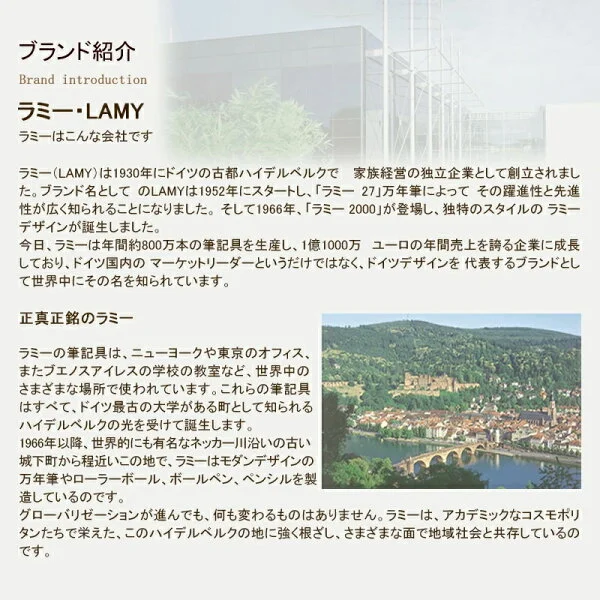
Lamy was founded in 1930 in Heidelberg, Germany by C. Josef Lamy. For the first three decades, Lamy was a conventional German pen maker in a crowded field. Then in 1966, they released the Lamy 2000 — designed by Gerd Alfred Müller, a graduate of the Bauhaus-inspired Ulm School of Design. The 2000 rewrote the company’s identity overnight. Lamy became, and remains, the brand of modernist industrial design in fountain pens.
In 1980, Lamy released the Safari — a deliberately youthful, colorful, plastic-bodied pen aimed at schoolchildren. The Safari became one of the best-selling fountain pens in history and defined Lamy for a generation of users who first picked up the brand as students.
Both companies are still family-controlled. Both have been remarkably consistent in design language. And both now compete in nearly every price range from under $25 to over $500.
Nib Philosophy
This is where the two brands differ most dramatically, and it is the single most important factor in choosing between them.
Pilot Nibs
Pilot nibs, especially their Japanese-made gold nibs, are known for being butter-smooth. Writing with a Pilot Custom 74 or Custom 823 feels effortless, almost frictionless — many writers describe the sensation as gliding on glass. The feedback is minimal. The ink flow is consistent. The tuning from factory is usually excellent.
Pilot also follows the Japanese nib sizing convention, which runs finer than European. A Japanese Fine is roughly equivalent to a European Extra Fine. A Japanese Medium is closer to a European Fine. If you are used to Lamy or Pelikan and try a Pilot Medium, you will find it noticeably narrower.
Pilot offers the widest selection of specialty nibs in the industry. The Custom 742 alone comes in 15 nib options including:
- Soft Fine (SF) and Soft Medium (SM) — slight spring
- Fine Medium (FM) — between F and M
- Falcon (FA) — semi-flex for line variation
- Waverly (WA) — upturned tip for smoothness at any angle
- Posting (PO) — ultra-fine for microwriting
If you care about nib variety and Japanese-style precision, Pilot wins.
Lamy Nibs
Lamy’s approach is the opposite. Most Lamy pens — including the entire Safari range — use interchangeable steel nibs that pop in and out by hand. The nib on a $25 Safari is the exact same nib unit as on a $90 Studio or $150 Lamy CP1. You can buy a replacement nib for $20 and swap sizes in thirty seconds.
This modularity is a huge advantage for beginners. You can buy a Safari in Fine, then try Medium, then try the 1.1mm Stub, without buying three pens. My beginner’s guide covers this starter path.
Lamy nibs write with moderate wetness and more feedback than Pilot’s. They are not scratchy — just more tactile. The steel nibs are well-tuned but lack the subtle character of Pilot’s gold nibs. They feel like reliable tools rather than refined instruments.
Lamy follows European sizing conventions. A Lamy Medium writes noticeably broader than a Pilot Medium. If you want a finer line with Lamy, go down a size.
Lamy’s gold nib offerings are limited. The Lamy 2000 has a semi-hooded 14K nib in F/M/B/BB. The Studio, Dialog, and Imporium offer 14K options. But there is nothing approaching Pilot’s 15-variant specialty lineup.
Which Nib Style Suits You?
- Glide over paper, no feedback, narrow lines: Pilot
- Tactile feel, broader lines, modular swapping: Lamy
- Want to experiment with nib grinds cheaply: Lamy (Safari makes regrinds affordable)
- Want specialty Japanese grinds: Pilot
For a deeper dive on nib choice, see my nib size guide and gold vs steel comparison.
Entry Pens: Metropolitan vs Safari
This is where most writers meet each brand for the first time.
Pilot Metropolitan (~$20): A brass-bodied entry pen with a steel nib. The weight is surprising — around 27g, noticeably heavier than the Safari. The nib is smooth Japanese-made steel, closer in feel to Pilot’s gold nibs than to typical entry-level steel. Available in Fine and Medium, with simple black/silver designs (though Pilot rotates colors).
Lamy Safari (~$25): A plastic-bodied pen with a triangular grip section that forces a specific pencil-style hold. The nib is interchangeable steel. Colors are aggressively bright — mango, candy, aquamarine, and an annual limited-edition color that collectors chase. Weight is around 17g, making it feel lighter and more “pen-like” than the Metropolitan.
The two pens define their brands perfectly.
- The Metropolitan feels like a piece of precision hardware.
- The Safari feels like a design object you carry around to be seen.
The Metropolitan writes finer and smoother out of the box. The Safari is more versatile thanks to swappable nibs. Many writers eventually own both. For a comparable Safari-class comparison at the entry level, see my Lamy Safari vs TWSBI Eco comparison.
Mid-Tier: Custom 74 vs Lamy 2000
This is where both brands hit their stride. Both the Custom 74 ($160) and Lamy 2000 ($170) are widely considered the “pen everyone should own at least once” in their respective ecosystems.
Pilot Custom 74: A translucent resin barrel with a conventional clipped cap. Uses a 14K gold nib available in SF, F, FM, M, B, BB, and several specialty grinds. Fills with the CON-70 converter (high capacity) or cartridges. Writing experience is smooth, refined, and slightly wet.
Lamy 2000: A Makrolon (fiberglass-reinforced polycarbonate) barrel with a semi-hooded 14K gold nib. Filling is a proper piston, with roughly 1.4ml of ink capacity. The nib is more restrained and slightly drier than the Custom 74.
Specification-wise, the Lamy 2000 is arguably the more engineered pen — the piston is superior to any converter, and the Makrolon barrel is more durable than resin. Design-wise, the 2000 is iconic in a way the Custom 74 is not.
Writing-wise, I find the Custom 74 more consistently enjoyable. Pilot’s QC is bulletproof. Lamy 2000 samples vary — some are flawless, some need a nibmeister visit. If you hate the idea of sending a new pen out for tuning, buy the Custom 74.
For a full exploration of this tier, my under-$200 guide covers both pens in detail alongside other strong contenders.
Filling Systems
Pilot offers the most variety of any fountain pen maker. The Custom 823 uses a vacuum filler with massive ink capacity. The Vanishing Point uses cartridge/converter. The Custom 74 and 742 use the CON-70 or CON-40 converter. The older Custom Heritage 92 is a piston filler. Pilot will build the mechanism that fits the pen.
Lamy is more conservative. Most Lamy pens (including Safari, AL-Star, CP1, Studio, and Aion) use cartridge/converter with the proprietary Z28 converter. The Lamy 2000 is a piston filler. The Dialog 3 is a twist-retractable. The Imporium uses cartridge/converter. Compared to Pilot’s range, Lamy’s mechanisms are simpler and more uniform.
For depth on how these systems compare, see my filling systems guide.
Ink Compatibility
Both brands use proprietary cartridges — Pilot’s are long and narrow; Lamy’s are standard-sized but proprietary-fit. Neither brand accepts standard international cartridges on most pens.
Pilot: CON-40 and CON-70 converters work across most of the Custom line. The Metropolitan accepts a CON-40 or Pilot cartridges. Pilot inks (Iroshizuku especially) are universally compatible with their own pens.
Lamy: The Z28 converter fits nearly every Lamy pen — Safari, AL-Star, Studio, CP1. Lamy cartridges are proprietary but widely available. Third-party ink from Diamine, Robert Oster, and others works fine.
A practical tip: if you buy into Lamy, stock up on the Z28 converter. It is often the limiting factor in how many pens you can ink simultaneously. For ink recommendations, my best fountain pen inks guide covers pairings.
Service Availability
This is an underrated factor and worth naming.
Pilot: Repair and service in Japan are excellent but international support varies. In the US, Pilot USA handles repairs for pens sold through authorized dealers. Turnaround is 4-6 weeks. Specialty grinds can only be done by nibmeisters, not Pilot itself (outside Japan).
Lamy: Global warranty and service. Lamy has a strong authorized service network in Europe and reliable coverage in the US. Nib swaps are trivial — buy a replacement nib and change it yourself. This modularity removes most service needs entirely.
For everyday support, Lamy is easier. For serious nib work, both require third-party nibmeisters.
Design Language
Pilot’s design is restrained and tool-like. The Custom line uses conservative shapes — cylindrical barrels, simple clips, subtle branding. The Vanishing Point is the exception, a genuinely distinctive design. But most Pilot pens look at home on a banker’s desk, not in a design magazine.
Lamy’s design is the opposite — deliberate, confident, and modernist. Every Lamy pen looks like it was drawn on a clean sheet of paper by someone thinking about the object first. The Safari is unmistakable from across a room. The 2000 is on display at the Museum of Modern Art. The Studio’s rotating clip is unlike anything else on the market.
If you care about how a pen looks on your desk, Lamy has the upper hand. If you care about how it feels in your hand, the brands are evenly matched.
Comparison Table
| Category | Pilot | Lamy |
|---|---|---|
| Founded | 1918 (Tokyo, Japan) | 1930 (Heidelberg, Germany) |
| Entry pen | Metropolitan ($20) | Safari ($25) |
| Mid-tier flagship | Custom 74 ($160) | Lamy 2000 ($170) |
| Nib character | Butter-smooth, precise | Tactile, modular |
| Nib sizing | Runs fine (Japanese) | Runs broad (European) |
| Specialty nibs | Extensive (FA, WA, PO, etc.) | Limited |
| Filling systems | Vacuum, CON-70, piston, cartridge | Cartridge/converter, piston |
| Nib swappability | Not user-swappable (most) | User-swappable (most) |
| Design language | Conservative, tool-like | Modernist, distinctive |
| Service | Regional, slower | Global, streamlined |
Who Should Pick Which
Choose Pilot if:
- You prioritize writing experience over visual design
- You prefer fine-to-medium line widths
- You want access to specialty nib grinds (Falcon, Waverly, Posting)
- You plan to buy a Vanishing Point eventually
- You want the smoothest possible writing feel
Choose Lamy if:
- You value design as much as performance
- You like experimenting with different nib sizes affordably
- You want one pen system with interchangeable parts
- You prefer slightly broader, wetter lines
- You want global service and warranty support
Many serious writers own both. Pilot for everyday writing, Lamy for design appreciation and nib experimentation. The two brands are not substitutes — they serve different impulses.
If you are just starting out, my beginner’s guide walks through the first-pen decision more broadly. And if budget is tight, my pens under $100 guide covers entries from both brands.
FAQ
Are Pilot and Lamy pens compatible with the same ink?
Almost always yes. Both accept bottled ink via their respective converters, and both work with third-party inks from Diamine, Noodler’s, Robert Oster, and others. Pilot’s Iroshizuku inks are popular across both systems. Cartridges are not interchangeable — Pilot uses proprietary cartridges, as does Lamy.
Which brand is better for beginners?
Lamy, for most people. The Safari is more forgiving (the triangular grip teaches correct hold), the nib is user-swappable, and replacement nibs are cheap. Pilot’s Metropolitan is arguably the better pen out of the box, but Lamy’s modularity makes it the better learning platform.
Do Pilot nibs really write finer than Lamy?
Yes, noticeably. A Pilot Fine writes roughly as fine as a Lamy Extra Fine. A Pilot Medium writes closer to a Lamy Fine. If you are switching brands, size down by one.
Is the Lamy 2000 really worth the price?
It is if you value the design heritage and the piston filling system. If you only care about writing quality, the Pilot Custom 74 at a similar price is more consistent out of the box. The 2000 is an icon; the Custom 74 is a tool. Both are valid choices.
Can I put a Pilot nib on a Lamy pen or vice versa?
No. Nib units are proprietary and not interchangeable between brands. Some nibmeisters can swap tipping material, but full nib swaps between brands are not practical.
Which brand has better build quality?
Both are excellent but in different ways. Lamy’s metal-bodied pens (Studio, Aion, Imporium) are extremely solid. Pilot’s pens feel lighter and more delicate but are equally durable in practice. Lamy edges out slightly for absolute toughness; Pilot edges out slightly for refinement.
Is the Pilot Vanishing Point worth it over a regular Lamy?
If you take a lot of quick notes during the day, yes. The one-handed click operation is genuinely useful. If you sit at a desk and write for extended periods, a regular capped pen (from either brand) is more comfortable.
Which brand has better resale value?
Neither is a strong investment brand. Special editions and limited colors of the Lamy Safari retain some value. Vintage Pilot Custom pens have a small collector market. Neither is comparable to Pelikan M800 or Montblanc for resale. Buy these pens to write with, not to hold.
Final Thoughts
Pilot and Lamy represent two legitimate philosophies of what a fountain pen should be. Pilot treats the pen as a precision instrument, engineered for the writing experience. Lamy treats the pen as a designed object, built for modularity and visual identity. Neither is wrong.
If forced to pick, I carry a Pilot more often than a Lamy. The Custom 74 is the pen I have used most in the last three years. But the Lamy Safari was my first fountain pen, and it is still the pen I hand to friends who want to try the hobby. Both brands earn their place on my desk, and both will likely earn a place on yours.
Start with whichever aligns with your instincts. If you need a tool, start with Pilot. If you need an object, start with Lamy. You can always own both later.
🖊️ Featured Pens in This Article