Guide
Best Fountain Pens Under $30 in 2026: Maximum Value, Minimum Spend
Published: 2026-05-10 · Updated: 2026-05-10
Here’s something the fountain pen internet doesn’t say loudly enough: under $30 is where most people should start, and where a lot of people should just stay. You do not need to spend $150 to find out whether you like writing with a fountain pen. The pens in this band are not “good for the money” in a compromised, apologetic way — several of them are genuinely good pens, full stop, that happen to cost less than a nice lunch.
This is a tighter band than my best fountain pens under $50 roundup. That article is the next tier up — slightly nicer bodies, the first gold nibs, more refinement. This one is about the absolute cheapest pens that write well: roughly $5 to $30. If you’ve never owned a fountain pen, start here, not there. Spend $20, see if you fall for it, then climb.
What $30 Gets You (and What It Doesn’t)
Let’s be honest about the trade-offs, because every recommendation below lives inside them.
What you get under $30:
- A steel nib that writes smoothly and reliably. Steel is the great equalizer — a $20 Pilot nib writes beautifully.
- A perfectly good body. Some plastic, some metal, all functional and often genuinely nice-looking.
- Full ink flexibility if you add a converter (more on that below).
- Zero anxiety. You’ll actually use a cheap pen, throw it in a bag, lend it out. That matters more than people admit.
What you don’t get:
- Gold nibs. Those start around $80–150. Gold adds a springy, slightly softer feel — pleasant, but not essential, and you won’t miss it until you’ve tried one.
- Premium materials. No resin that feels like a luxury object, no fancy filling mechanisms, no precious-metal trim.
- Nib tuning out of the box. Cheap pens are made to a price; occasionally one needs a tiny tweak. Usually they’re fine.
None of that should stop you. The gap in writing experience between a $20 pen and a $200 pen is far smaller than the price gap suggests. The first $20 buys you 80% of the magic.
The Picks (All Genuinely Under $30)
~$5 — Platinum Preppy
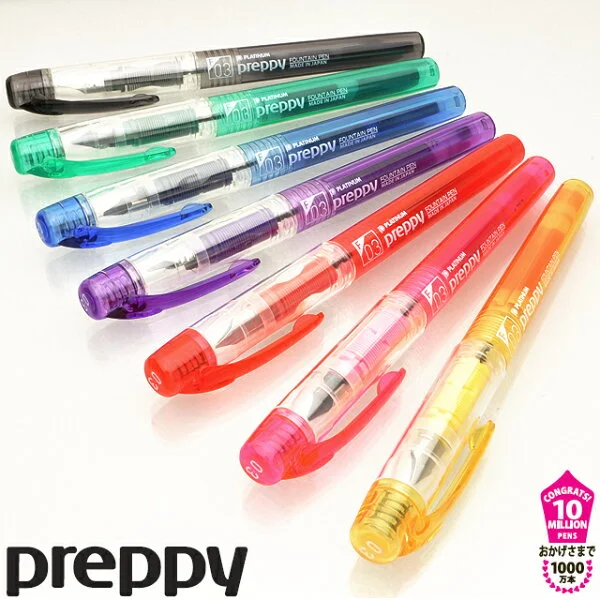
The Preppy is the cheapest pen on this list and one of the most beloved fountain pens in the world. Five dollars buys you a real Platinum steel nib that writes a clean, fine line, plus Platinum’s Slip & Seal cap that keeps ink wet for months — a feature you usually pay a lot more for.
The body is unapologetically cheap plastic, and that’s the point: it’s nearly disposable, so you’ll use it fearlessly. The famous eyedropper-mod trick turns it into a high-capacity workhorse — seal the threads with a little silicone grease, fill the whole barrel with bottled ink instead of a cartridge, and you get an enormous ink reservoir for pennies. It’s the perfect first experiment.
Buy it if: you want to spend the least possible money to find out if fountain pens are for you.
~$8 — Pilot Varsity (and the Kakuno)
The Pilot Varsity is a disposable fountain pen, pre-filled and ready to write out of the package. It’s the gentlest possible on-ramp: no cartridges, no converter, no decisions. The nib is a smooth Pilot medium, and the ink is good. When it runs dry, you toss it — though clever people refill them too.
In the same price neighborhood sits the Pilot Kakuno, a refillable, friendly, ergonomic pen with a smiley face stamped on the nib (genuinely — it helps beginners orient the nib correctly). I’ll say more about it next because it’s the better long-term buy.
Buy the Varsity if: you want the absolute zero-effort introduction with nothing to learn.
~$10–15 — Pilot Kakuno (plus honest mentions)
The Kakuno is, for my money, the best $12 fountain pen made. It takes the same excellent Pilot steel nib as the Metropolitan, in a light, comfortable triangular-grip body designed to teach a proper grip. It’s marketed at students but writes like a pen costing three times more. Add a converter and it drinks any bottled ink you like.
Now the honest mention nobody on the budget end avoids: Chinese pens like Jinhao and Wing Sung. A Jinhao can be had for a few dollars and some are remarkably good writers. The catch is consistency — quality varies unit to unit, and you may need to fiddle with a nib that arrived dry or scratchy. If you enjoy tinkering, they’re fun cheap thrills. If you just want a pen that works, spend the extra few dollars on a Pilot.
Buy the Kakuno if: you want the single best-value refillable starter pen.
~$20 — Pilot Metropolitan (best overall under $30)
If you buy one pen from this entire article, make it the Metropolitan. It is the pen I hand to everyone who’s curious. For around twenty dollars you get a metal body with real heft, clean understated styling that looks far more expensive than it is, and that same superb smooth Pilot steel nib. It comes with both a cartridge and a squeeze converter in the box, so you can use bottled ink from day one.
There is nothing about the Metropolitan that feels cheap in the hand. It’s the rare budget pen that a serious enthusiast will still keep in rotation years later. This is the benchmark every other pen here is measured against.
Buy it if: you want the best all-round fountain pen under $30. (Most people.)
~$22 — Platinum Plaisir
The Plaisir is, essentially, a Preppy in a proper aluminum body. Same excellent Platinum nib, same Slip & Seal cap that resists drying out, but now wrapped in a durable anodized-metal barrel that comes in lovely colors and feels genuinely solid. It’s the upgrade path for anyone who loved their Preppy nib but wanted a grown-up body.
Buy it if: you want Platinum’s dry-out-proof reliability in a metal pen, or your pens sit unused for stretches.
~$25–30 — Lamy Safari (top of this band)
The Safari sits right at the ceiling of “under $30” and is the most iconic budget fountain pen in the world. German-made, with a distinctive industrial design, a molded triangular grip, and a smooth steel nib that’s easy to swap for a different width later. The body is sturdy ABS plastic — deliberately tough, made to be used and abused.
A couple of honest notes: the converter is sold separately (budget another ~$5), and that triangular grip is divisive — most people love it, some find it forces an unnatural hold. Try before you commit if you can. If you’re weighing it against the obvious rival at this price, I broke that down in Lamy Safari vs TWSBI Eco.
Buy it if: you want a tough, swappable-nib daily pen and you get on with the grip.
Under $30 vs Under $50: Is It Worth the Jump?
So should you just spend a bit more? Sometimes — but later, not first.
The jump from this band to the best fountain pens under $50 tier buys you nicer bodies (the TWSBI Eco’s see-through piston filler, the Lamy AL-Star’s aluminum), a bit more refinement, and slightly more interesting designs. What it does not buy you is a dramatically better writing experience — the steel nibs are largely the same calibre. You’re paying for the object, not the line on the page.
My advice: start under $30. Buy the Metropolitan, or the Kakuno if you’re truly pinching pennies. Live with it for a month. If you find yourself reaching for it daily and wanting more, then graduate to the under-$50 tier, and eventually maybe a gold nib from my under-$100 roundup. Don’t skip the cheap step. It’s how you learn what you actually like before spending real money.
A Word on Converters and Cartridges
Every cheap pen takes ink one of two ways, and it trips up beginners constantly:
- Cartridges are sealed plastic ink capsules. Pop one in, done. Convenient, but you’re limited to the colors that brand sells, and cartridge shapes are proprietary — a Pilot cartridge won’t fit a Lamy.
- Converters are little refillable pistons that let you draw ink from a bottle, opening up hundreds of colors. Most pens here come converter-ready; some (like the Safari) sell the converter separately for about $5.
My recommendation for anyone past the curious stage: buy one bottle of good ink and a converter. Bottled ink works out far cheaper per page than cartridges, and the colors are half the fun. If you want help picking, see my best everyday fountain pen inks. And whatever pen you choose, its nib width changes everything about how the ink looks — my nib size guide explains how to pick.
What to Avoid
One firm warning: stay away from the no-name “fountain pen multipacks” on Amazon — the ones offering ten pens for $15 from a brand you’ve never heard of with a random string of letters for a name. They look like a bargain and they are not. The nibs are inconsistent, often scratchy or dry, the feeds skip, and the build quality is genuinely poor. A single bad first pen convinces more people that “fountain pens just aren’t for me” than anything else.
You will have a dramatically better experience with one $5 Platinum Preppy than with a ten-pack of mystery pens. Spend on a known name — Pilot, Platinum, Lamy — even at the very bottom of the price range. The brands above have a reputation to protect, and it shows in every unit.
Comparison at a Glance
Platinum Preppy — ~$5 Cheapest real nib; Slip & Seal; eyedropper-moddable. Best for: testing the waters for pocket change.
Pilot Varsity — ~$8 Disposable, pre-filled, zero setup. Best for: the no-effort first try.
Pilot Kakuno — ~$12 Excellent Pilot nib, ergonomic, refillable. Best for: best-value refillable starter.
Pilot Metropolitan — ~$20 Metal body, superb nib, converter included. Best for: best overall under $30.
Platinum Plaisir — ~$22 Preppy nib in a metal body; dry-out-proof. Best for: reliable metal pen for occasional use.
Lamy Safari — ~$25–30 Tough, iconic, swappable nibs. Best for: durable daily pen (if you like the grip).
FAQ
What’s the single best fountain pen under $30? The Pilot Metropolitan, at around $20. Metal body, smooth nib, converter included — nothing else at the price matches the whole package.
What’s the cheapest pen that’s actually good? The Platinum Preppy at about $5. It’s not a toy — it’s a genuinely good writer with a real Platinum nib.
Are cheap fountain pens worth it, or do I need to spend more? They’re absolutely worth it. The writing experience gap between a $20 pen and a $200 pen is far smaller than the price gap. Start cheap.
Can I use bottled ink in these? Yes, with a converter (included with the Metropolitan, sold separately for the Safari). The Preppy and Plaisir can also be eyedropper-converted. Bottled ink is cheaper per page and unlocks every color.
Are Chinese pens like Jinhao any good? Some are surprisingly good for a few dollars, but quality varies unit to unit and you may need to tune the nib yourself. Fine if you enjoy tinkering; otherwise buy a Pilot.
Should I get a fine or medium nib? Mediums are smoother and more forgiving for beginners; fines suit small handwriting and cheaper paper that bleeds. Japanese fines run finer than European ones. See my nib size guide.
Will a cheap nib feel scratchy? A good cheap pen (the brands above) writes smoothly out of the box. Scratchiness is mostly a problem with no-name multipack pens — avoid those.
When should I upgrade to the $30–50 tier? When you find yourself using a fountain pen daily and wanting a nicer object in your hand. Then move up to the under-$50 picks — not before.
The Honest Downsides
Buying at this tier isn’t free of trade-offs, so let me be straight about them. These pens are made to a price: the resins and plastics won’t feel luxurious, the trim is simple, and you’re using steel nibs, so you’ll miss out on the soft spring of gold (until you try gold, you genuinely won’t notice). Occasionally a budget pen arrives needing a minor nib tweak. And the bottom-of-the-band disposables and Preppies, while brilliant value, are clearly built to be replaced rather than treasured.
But here’s the thing — none of that is a reason to spend more first. It’s a reason to start here, learn what you love, and let your second pen be the informed splurge. The cheapest genuinely-good pen you’ll actually use beats the expensive one you’re too nervous to take out of its box. Buy the Metropolitan, ink it up, and start writing. You can always climb the ladder later.
🖊️ Featured Pens in This Article